Establishing DAX Standards Across a BI Team
Two developers, one model, six months: that’s the full recipe for a naming scheme at war with itself, three formatting conventions, and measures that read like they were written in different companies. Nobody did anything wrong. They just each did it their way, and a model records every author’s habits forever.
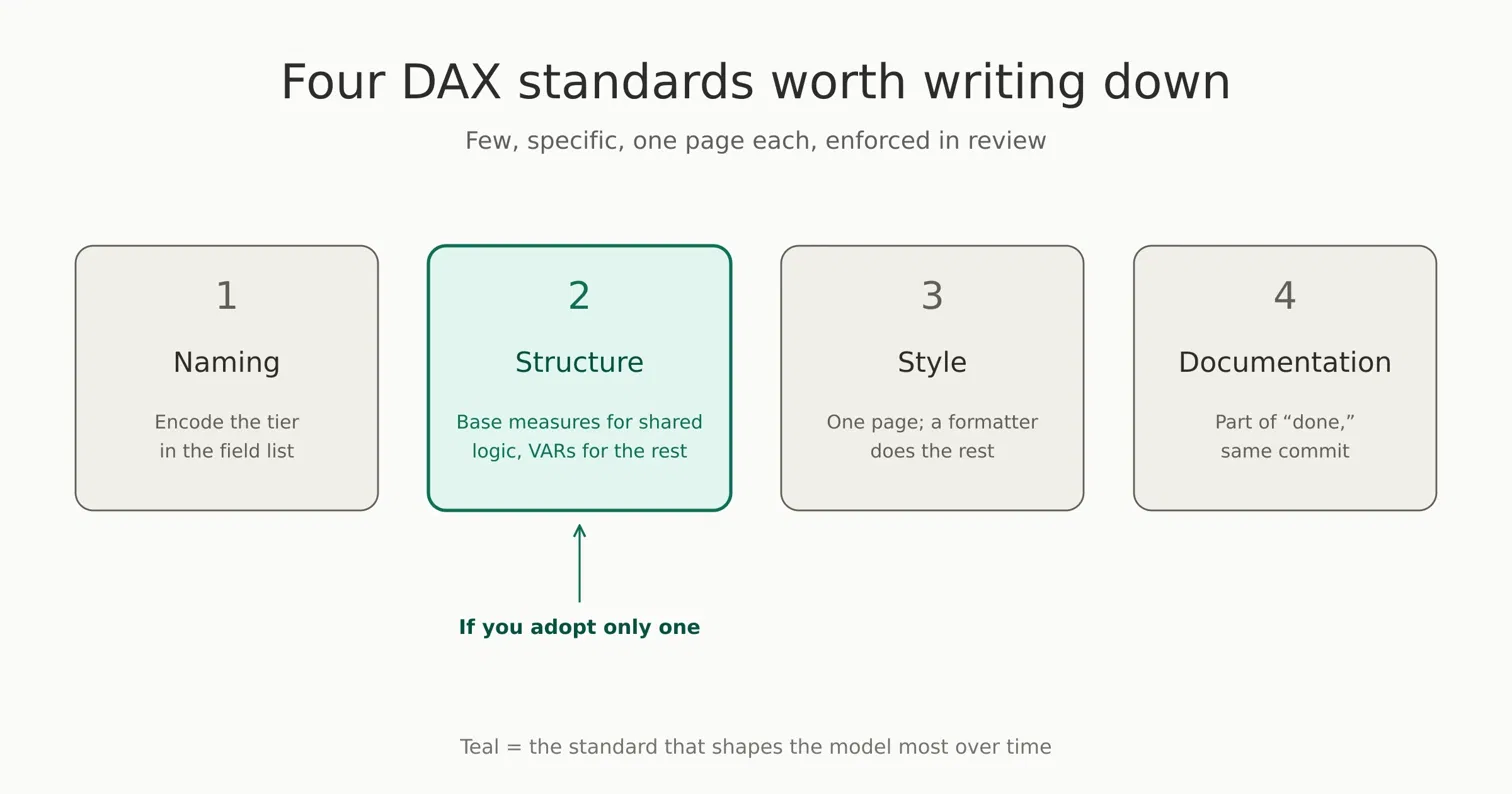
Standards fix this, but BI teams routinely over-scope them into forty-page style bibles that nobody reads and everybody resents. The standards that survive are few, specific, and enforced by process rather than memory. There are exactly four worth writing down.
Standard 1: Naming that encodes the tier
The field list is the interface everyone shares, so naming is the highest-leverage standard. The one structural rule that matters: a reader should be able to tell a foundational measure from a leaf at a glance. Pick any convention that achieves it. It could be a Base prefix for foundations, display folders per tier, or a suffix scheme for variants (Net Sales YoY %). The specific choice matters far less than its consistency.
Add the negative rules, which do most of the work: no version fossils (v2, FINAL), no temp or test in anything published, no near-duplicate names (Total Sales vs Sales Total). Each of these is a tech-debt signature the naming standard prevents at the source.
Standard 2: Structure is when logic becomes a measure
The architectural standard, and the one that shapes the model most over time:
- Shared logic lives in a base measure; single-use intermediates live in VARs. This is the VAR heuristic elevated to team policy. It’s what keeps the dependency graph shaped instead of tangled.
- Foundations are designated, not discovered. The team maintains the short list of measures others may build on. Building on a non-foundation measure is a review question, not a crime, but it’s asked every time.
- Foundation edits get the full review, upstream walk included. Blast radius is the rigor dial. Teams that adopt only one standard should adopt this one; naming makes a model readable, but structure is what keeps it shallow where it should be shallow.
Standard 3: Style, what are the formatting and DAX conventions?
The smallest section, deliberately. Pick a DAX formatter and make its output the standard. Arguing about indentation is a solved problem; delegate it to a tool. Then a handful of house rules: fully qualified column references (Sales[Amount]), unqualified measure references ([Net Sales]), explicit DIVIDE over the division operator, VAR names that mean something. One page, total.
Style standards past one page have negative value: every additional rule is another thing to police, and policing style is how standards efforts lose the room.
Standard 4: Documentation as part of “done”
The standard that keeps the other three alive: a change isn’t done until its documentation is. Every measure gets its one-line business definition at creation (cheap now, brutal to retrofit); model docs regenerate in the same commit as the change; and consciously deferred work goes in the debt register, in writing.
For teams operating at enterprise scale meaning multiple models, multiple teams, governance requirements; the documentation standard grows its own scaffolding, covered in documentation standards for enterprise teams. For a single team, the same-commit rule plus the one-liner habit is the whole standard.
Adoption without a rebellion
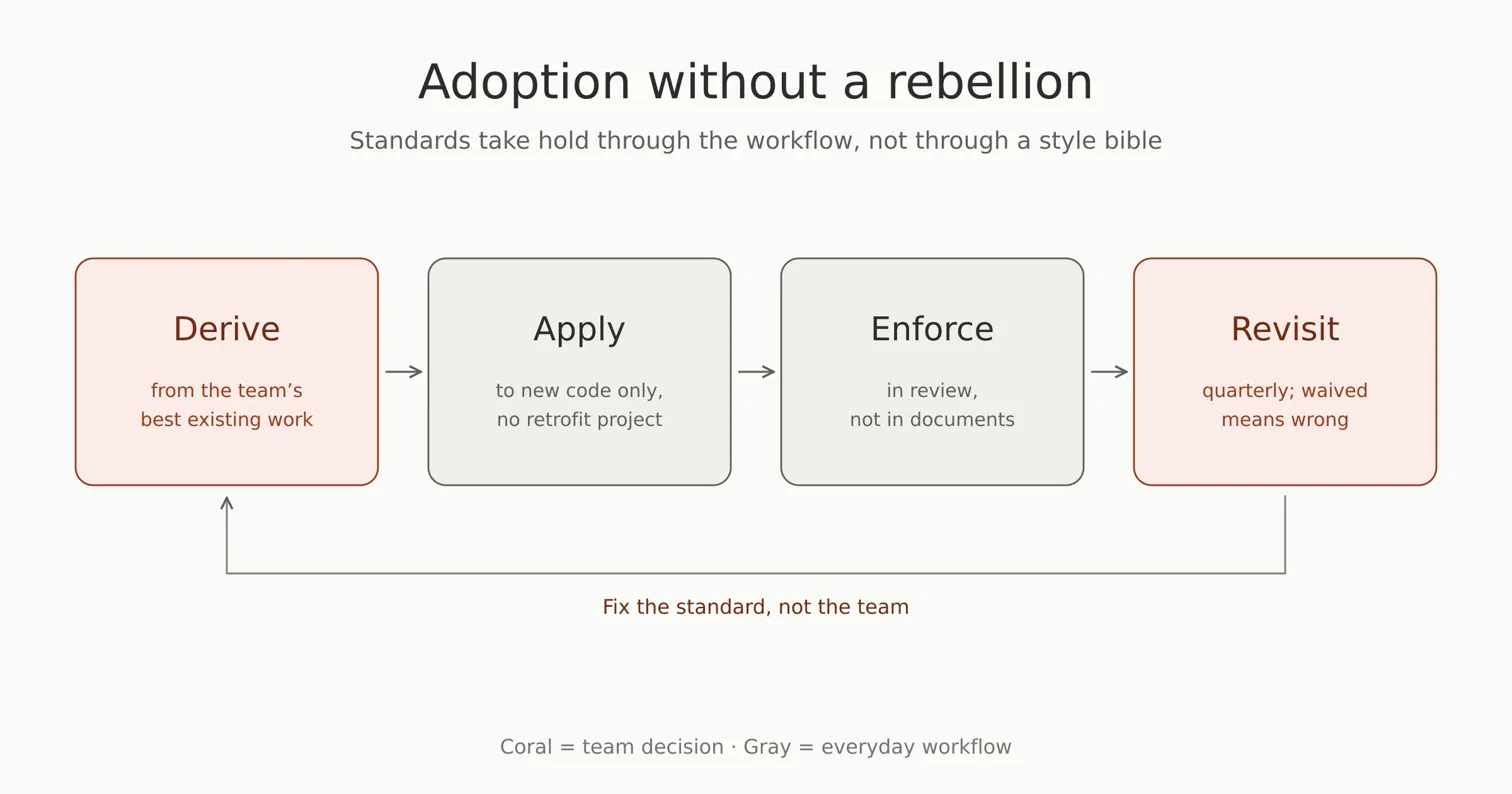
How standards actually take hold, in four moves:
New code only. The standard applies from today forward; the existing two hundred measures are not a renaming project. Retrofit mandates are where standards initiatives die. The old names get fixed opportunistically, when a measure is touched for other reasons, or as onboarding cleanup tasks.
Enforce in review, not in documents. The review checklist carries the standards; two rounds of review feedback teach house style better than any style guide read once. If a standard can’t be checked in review, it’s a wish, not a standard.
Derive, don’t decree. Write the first draft from what the team’s best existing work already does. Standards that codify the house’s actual good habits get adopted; standards imported from a blog post (including this one) get debated. Steal the categories here; fill them with your team’s answers.
Revisit quarterly. A standard that keeps getting waived in review is wrong, not under-enforced. Fix the standard.
The goal was never uniformity for its own sake. It’s that the model reads like one team built it so that the next reader, the next hire, and the next audit all start from coherence instead of archaeology. Four standards, one page each, enforced where the work happens. That’s the whole discipline.