Measure-on-Measure Dependency Chains Explained
Open Profit Margin % and the DAX looks harmless: it divides Profit by Sales. But Profit is itself a measure that subtracts Cost from Sales, and Cost references Base Cost with an allocation adjustment, and Base Cost… you get the idea. Nothing in the formula bar tells you that you’re standing four layers deep. That pattern, measures built on measures built on measures, is a measure-on-measure dependency chain, and it’s a difficult structure to deal with in any mature Power BI model because it’s invisible.
How chains form
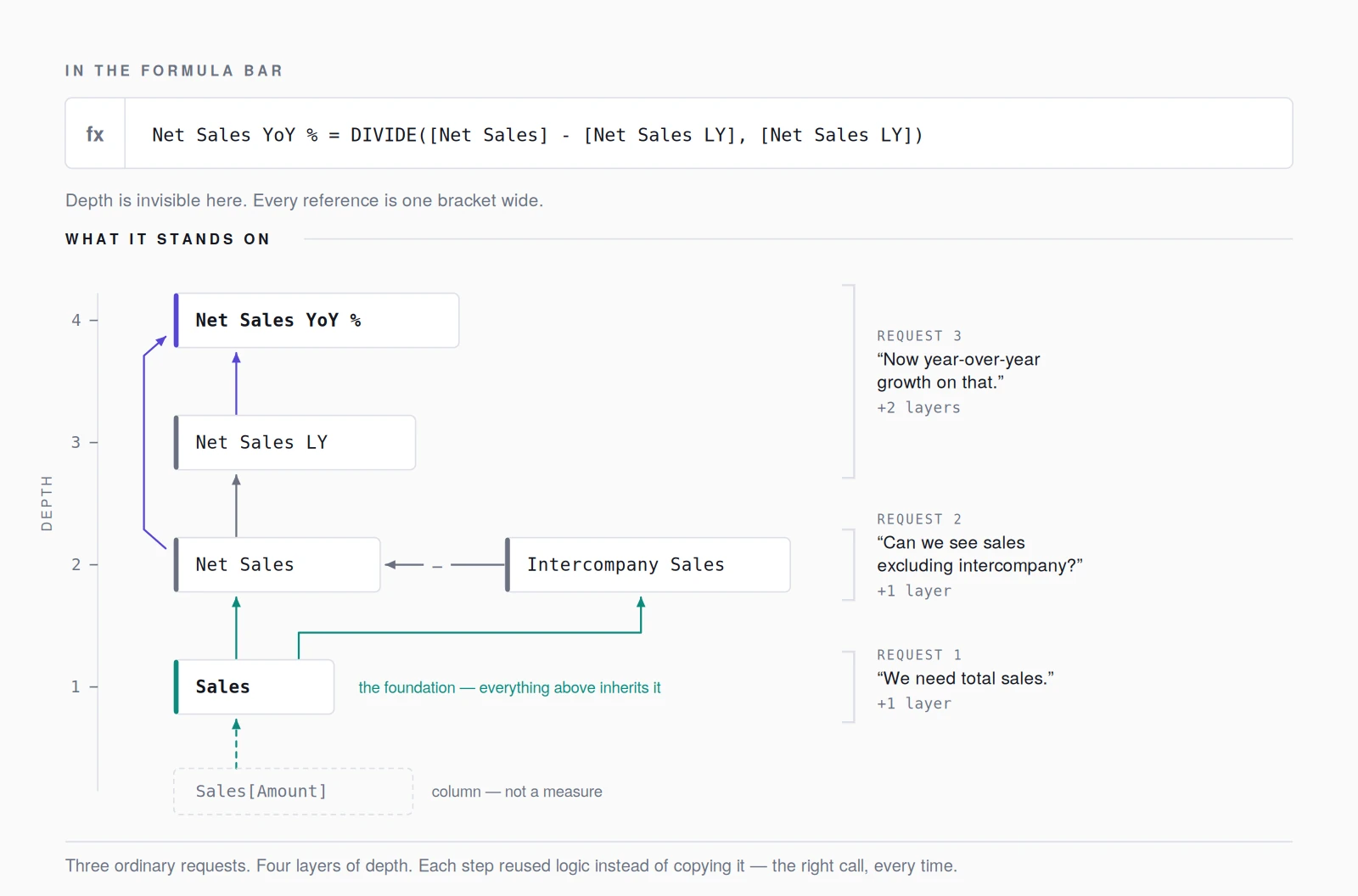
Nobody sits down and designs a dependency chain. Models grow them, one perfectly reasonable layer at a time. Watch it happen in three ordinary requests:
- “We need total sales.” You write
Sales = SUM(Sales[Amount]). One measure, one column. Depth: 1. - “Can we see sales excluding intercompany?” Rather than duplicating the logic, you write
Net SalesasSalesminusIntercompany Sales— which you also build onSaleswith a filter. Depth: 2. - “Now year-over-year growth on that.”
Net Sales YoY %comparesNet SalestoNet Sales LY, which wrapsNet Salesin a time-intelligence shift. Depth: 4.
Three sensible requests, four layers. Every step reused existing logic instead of copy-pasting it, which was the right call each time. Multiply by a few years and a few developers, and chains ten levels deep are unremarkable.
The good: chains are single source of truth
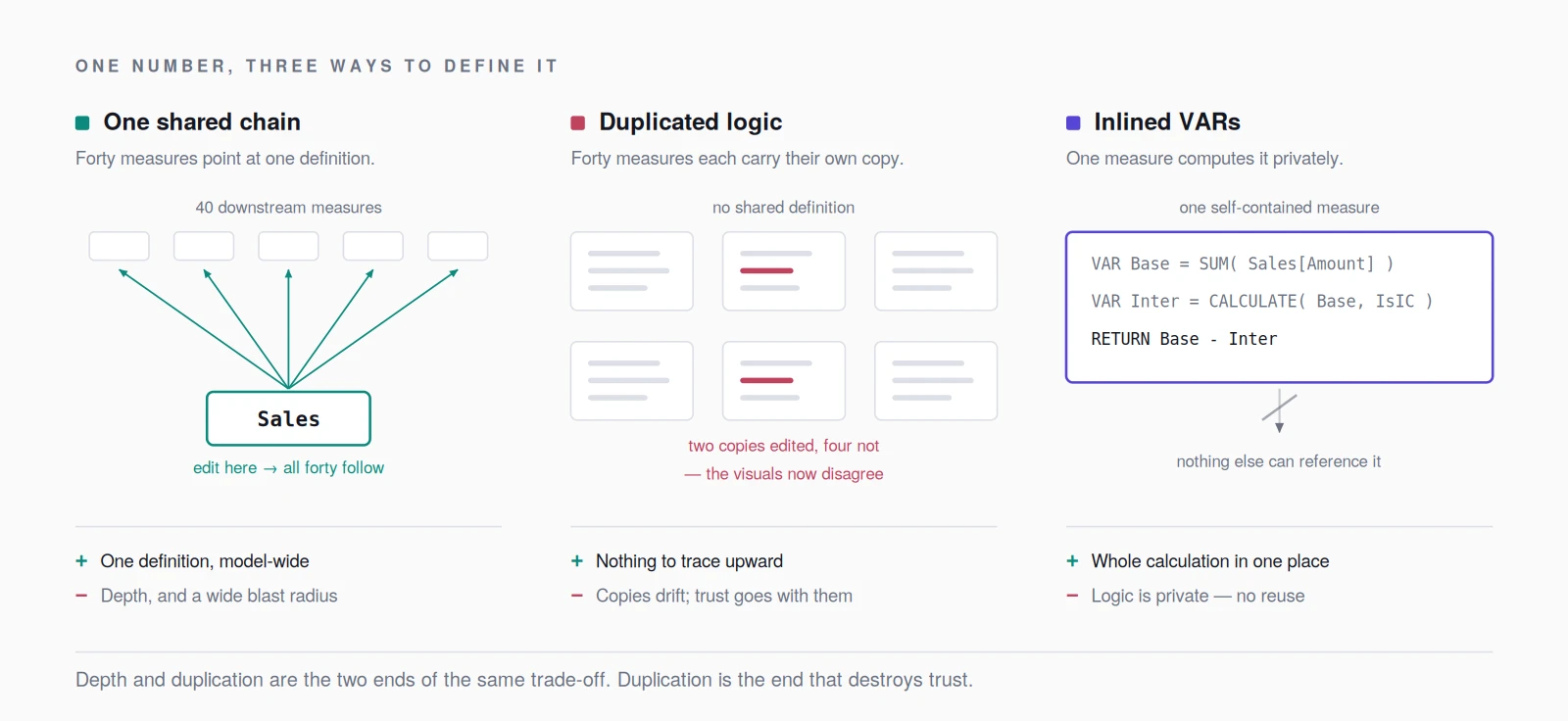
It’s worth being clear that chains are not a mistake. A shared base measure is DAX’s answer to the oldest rule in software DRY or don’t repeat yourself. Because forty downstream measures reference one Sales, there is exactly one definition of what “sales” means in the model. When the business changes that definition, something like a new exclusion or a currency fix, you change one measure and everything above it inherits the correction instantly.
The alternative is worse in every way that matters: forty measures each containing their own pasted copy of the sales logic, drifting apart one small edit at a time, until two visuals disagree about total sales and nobody can say which is right. Deep chains and duplicated logic are the two ends of the trade-off, and duplication is the end that destroys trust.
The bad: what depth costs
The same linkage that propagates fixes propagates everything else. Depth has three costs:
- Edit blast radius. Change a base measure and every measure above it changes too, only silently. The visuals won’t error; they’ll just show different numbers, which is the hardest kind of breakage to catch.
- Debugging distance. When
Net Sales YoY %looks wrong, the fault might be in the YoY logic, or inNet Sales, orIntercompany Sales, or the baseSalesfour layers down. Every layer is another place the bug can hide. - Onboarding load. Understanding one top-level measure means understanding its entire stack. A new developer can’t safely touch a depth-six measure until they’ve read six definitions.
A common instinct is to flatten chains with VAR/RETURN, computing intermediates inline instead of referencing measures. It works, but understand the trade: you gain locality (the whole calculation in one place) and lose reuse (that logic is now private to one measure). Flattening a shared base measure back into its forty consumers reintroduces exactly the duplication the chain existed to prevent.
Living with chains
So the goal isn’t to avoid chains, but to stop being surprised by them. Three habits get you there:
Know your chains. The chain is invisible in the formula bar but fully encoded in the DAX, which means a dependency tree can render any measure’s complete stack on demand. DAX Prism builds these automatically — depth stops being a mystery and becomes something you can simply look at. (Tracing measure dependencies in DAX covers the full method.)
Be deliberate about foundations. Some measures are meant to be built on, things like Sales, or Net Sales. Name them clearly, document them first, and keep their definitions boring and stable. An accidental foundation is a measure forty things depend on that nobody realized was foundational.
Treat base-measure edits as high-blast-radius changes. Before touching anything low in a chain, walk the tree upstream to see everything that inherits the change and then decide whether you’re fixing one number or forty.
Chains are leverage: one definition, reused everywhere. Unmapped chains are the same leverage pointed at you. The difference is whether you can see them.